Art House
The Augmented Intelligence Engine
Our Take
Serhii Mykytenko and Justin Fredericks looked at the advertising industry and saw a problem everyone's been ignoring: AR experiences still require downloading an app, and let's be honest, nobody's got time for that. So they built Art House—a platform that lets brands publish interactive AR directly from the camera, no app required. Scan a poster, tap a billboard, open a package, and boom—holograms, immersive overlays, and interactive content just appear. No friction, no download, no patience required.
Here's why this matters. The average consumer gives a brand exactly zero seconds to convince them to download something. AR has been stuck in the "cool tech demo" phase for years because it demanded app installation. Art House kills that bottleneck entirely. Their spatial engine delivers AR experiences in real-time, works across any piece of media—billboards, packaging, murals, signage, even TV commercials—and it scales because it runs natively in the camera people already have on their phones. This is the difference between AR as a novelty and AR as a marketing channel.
They've already convinced some heavy hitters: Gucci for augmented billboards, Wendy's for interactive commercials, Disneyland for augmented signage, Kellogg's Rice Krispies for AR packaging, Mastercard for event trophies, Sephora for retail collabs, Compass for real estate postcards. That's not a pitch deck—that's real brands putting real money into real campaigns. Art House is based in the AR/VR capital of the world and they're looking for brands ready to stop talking about "immersive experiences" and actually ship them.
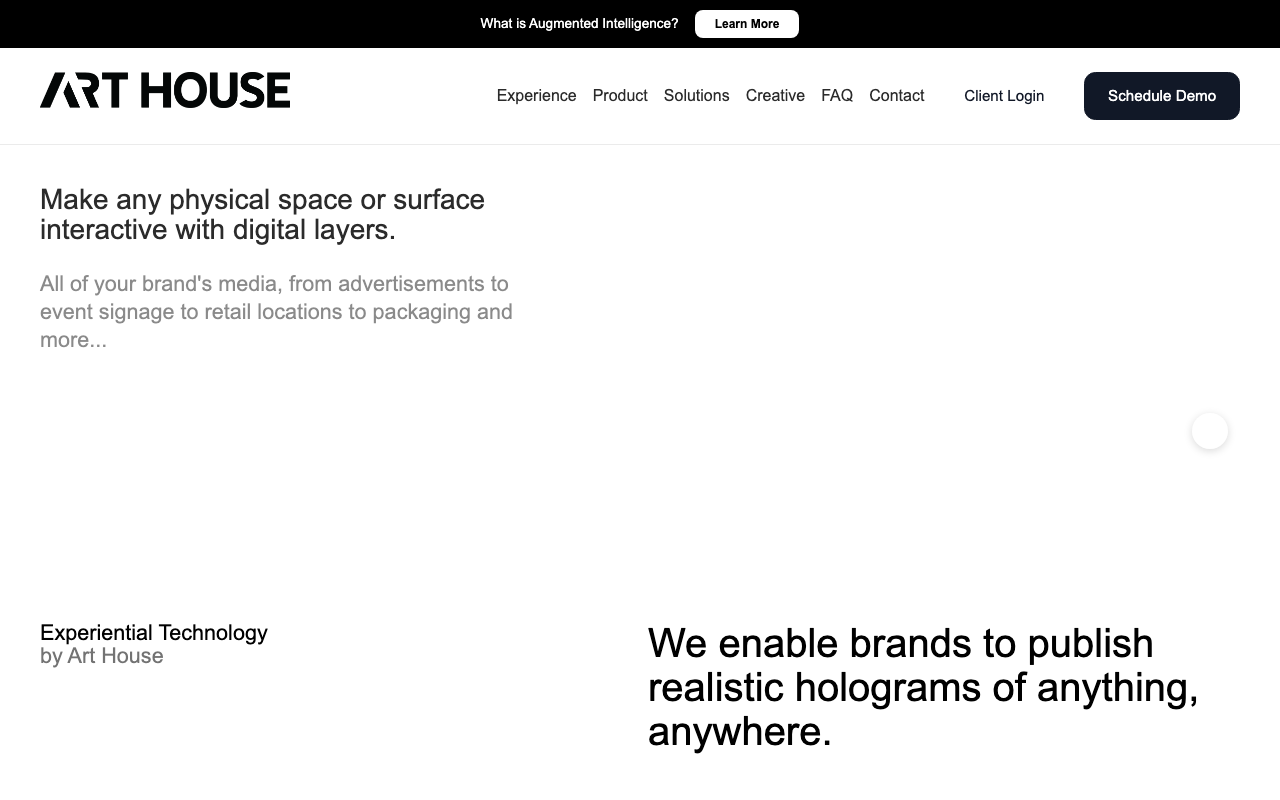
An augmented intelligence engine that enables brands to publish realistic holograms of anything, anywhere. Makes brand media interactive without requiring an app, working with smartphones today and wearables of tomorrow.
Key Facts
Links
Browse by category
Want products like this in your inbox every morning?
Five products. Every morning. Written by someone who actually cares whether they're good or not. Free forever, unsubscribe whenever.