Opbox – CRDT based sync for text files on disk
Real-time sync for plaintext files
Our Take
Opbox is what happens when you ask "what if git and Google Docs had a baby?" — except instead of fighting over documents, you get CRDT-powered real-time sync at the filesystem level. It's an open-source daemon that turns any directory of text files into a collaborative, multi-player workspace without forcing you to abandon your editor of choice. Think of it as git that works between commits, syncing your edits instantly instead of waiting for you to stage, commit, and push.
Here's the pain it solves: you've got an Obsidian vault or a folder of markdown docs that multiple people need to edit simultaneously. Git is too slow for this workflow — you can't commit every single keystroke. But Opbox listens for file changes, diffs them against a shadow CRDT copy, and encodes edits as operations using yrs (the Rust port of Yjs). Those ops get end-to-end encrypted and appended to a shared log on s2.dev. Every other machine syncing with the workspace reads the ops, updates its CRDT documents, and boom — everyone sees the same files on disk. It handles the merge logic so you never get those nightmare conflict files.
The design is inherently local-first. The files on your disk are the source of truth, not some cloud database. If you go offline, the daemon just re-syncs later when it can exchange CRDT ops with the shared log. It ignores binary files (images, PDFs, etc.) because you can't reasonably convert arbitrary binary edits into CRDT operations — those stay in git where they belong. Opbox even seeds its .opboxignore from your existing .gitignore so you don't have to configure it twice.
This came out of s2.dev, and it's genuinely refreshing to see someone building sync infrastructure at the filesystem layer instead of just another collaborative editor. Most real-time collaboration tools force you into their UI. Opbox says "keep your editor, we'll handle the hard part." That's the kind of infrastructure work that enables everything else.
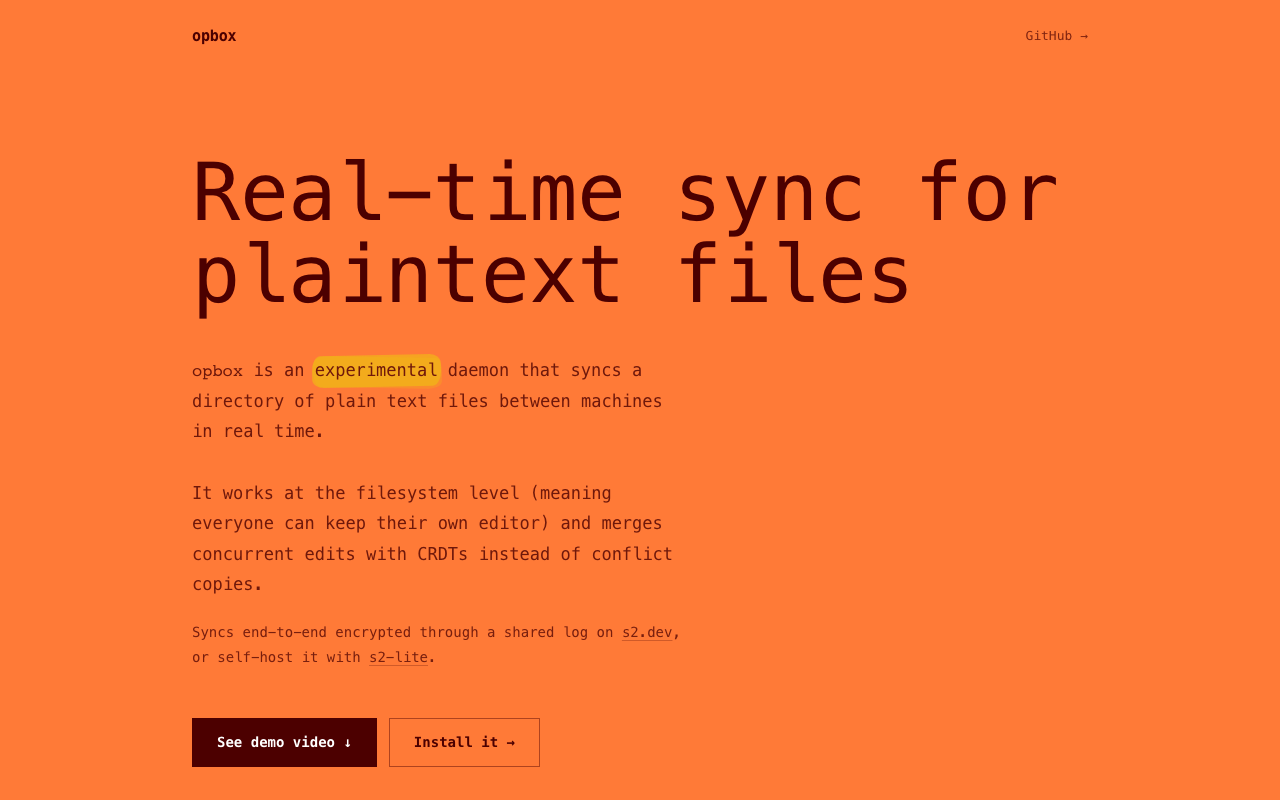
opbox is an experimental daemon that syncs a directory of plain text files between machines in real time.
Key Facts
The people behind Opbox – CRDT based sync for text files on disk
Links
Browse by category
Want products like this in your inbox every morning?
Five products. Every morning. Written by someone who actually cares whether they're good or not. Free forever, unsubscribe whenever.